
How to Write Ad Creatives for ChatGPT? How Do They Differ from Google Ad Copy?
rauf Uncategorized 0
How to Write Ad Creatives for ChatGPT? How Do They Differ from Google Ad Copy?

Writing for an AI chatbot is more like joining a conversation than shouting into a megaphone. While Google ads are built to win a quick click, chatgpt ads succeed by being the most helpful voice in the room. Here is how to master the art of the AI-native ad creative.
The Tonal Shift: From “Buy Now” to “Here is Help”
Google search ads often feel like a race. You see words like “Sale Ends Today” or “Lowest Price Guaranteed” because brands want you to click before you scroll away. This high-pressure style works when someone is just looking for a deal. However, when people use AI, they are usually in a different state of mind. They are deep in thought, trying to learn a new skill or solve a tricky problem.
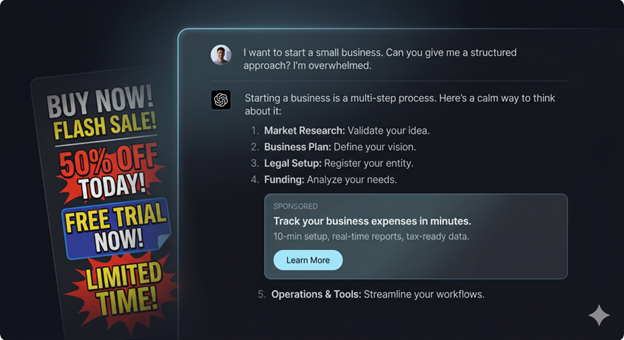
When you write for chatgpt ads, you need to act like a consultant. Instead of using loud, pushy words, use a tone that sounds like a smart friend giving a recommendation. If the AI just gave a long, calm explanation about a topic, a loud “BUY NOW” button will feel out of place. It breaks the user’s focus. Your copy should blend in by offering a way to make the task easier.
Swapping Search Urgency for Helpful Information
Urgency is a tool for search engines, but helpfulness is the tool for AI. If a user asks how to start a small business, they do not need a flashing “50% off” sign. They need a tool that helps them file their paperwork. By providing a useful resource instead of a sales pitch, your brand earns a spot as a trusted partner in their project.

Why ChatGPT Ads Avoid the Hard Sell
A hard sell often triggers a “no” from a user who is busy thinking. AI users want to keep the conversation going. They want more facts, not less. Because of this, ads that focus on solving a specific part of the user’s problem perform better. It is about being useful first and selling second.
Structure and Style: The Anatomy of an AI Ad
Visual style plays a big role in how your message is received. On a standard search page, ads look like the regular links. In a chat, chatgpt ads often show up in a small tinted box or a card. This clear frame tells the user that this is an extra resource. Because the chat can be very long, your ad needs to make sense on its own.
Someone might have been talking to the AI for twenty minutes before your ad appears. If your headline is too vague, the user will forget why it is there. You must write headlines that acknowledge the user’s current problem. For example, a bad headline would be “Check Out Our Services.” A good headline would be “Try this tool to track your business expenses.” The second one shows that you know what the user is currently doing.
Designing for the “Tinted Box” Format
The tinted box creates a separate space for your brand. This means you do not need to repeat the facts the AI just gave. Instead, use that space to show how your product fits into the story. Keep the text short and the layout clean. The goal is to look like a helpful add-on to the main chat.

Writing Contextual Headlines That Don’t Repeat the Prompt
Avoid repeating exactly what the user just asked. If they asked for “hiking tips,” do not start your ad with “Here are hiking tips.” They already know that. Instead, move to the next logical step. A headline like “Professional gear for your first mountain trek” shows that you are thinking ahead for them.
Ad Copy Rules: Data Over Fluff
In a chat, every word counts. Most people talk to an AI because they want clear, neutral facts. If your ad uses “fluff” like “the most amazing software ever,” it will stand out in a bad way. The AI usually speaks in a balanced and calm voice. If your ad sounds like a TV commercial, it will lose trust immediately.
To win with chatgpt ads, you should focus on data. Give the user specific details they can use. Mention things like a “5-year warranty” or “10-minute setup time.” This is what experts call information density. It means giving the most value in the fewest words. Users love this because it helps them make a decision without having to read a long sales page.
Using Information Density to Build Trust
Trust is built through honesty and clarity. When you list specific features or clear prices, you show that you have nothing to hide. AI users are often looking for the “best” way to do something. By providing hard facts, you prove that your brand is the “best” without actually having to say the word.
Matching the AI’s Explanatory Flow
The AI explains things step by step. Your ad should follow that same rhythm. If the chat is about a complex topic, your ad should offer a clear, simple tool to handle that complexity. Matching the flow means your ad feels like a continuation of the answer rather than an interruption.
Call to Action: The Natural Next Step
The call to action (CTA) is where you tell the user what to do next. On Google, “Shop Today” is a very common choice. In a chat, that might feel a bit too fast. Remember, the user is likely still in the research phase. They are trying to understand their options. Pushing them to buy right away can cause them to close the chat.
Instead, find a CTA that feels like a natural part of the journey. If you are helping them compare products, “See the Comparison” is a great choice. If they are looking for a custom solution, “Get a Custom Quote” works well. These choices lower the friction. They make the user feel like they are still in control of the conversation.
Finding CTAs That Match the Conversation Journey
Every conversation has a beginning, a middle, and an end. If the user is at the beginning of their search, your CTA should be light, like “Learn the Basics.” If they are near the end, you can be more direct. Matching the CTA to where they are in the chat shows that your brand is paying attention.
Why “Learn More” Often Beats “Shop Today” in ChatGPT Ads
“Learn More” is a safe bridge. It tells the user that there is more helpful information waiting for them. Since they are already in a learning mindset, they are much more likely to click. It feels like a low-risk way to get the help they need without the pressure of a checkout screen.
Leave a Comment